
Wines
from Spain

Discover the diversity of wines from Spain
Spain is one of the world’s leading wine-producing countries and home to one of the richest and most diverse wine cultures on the planet. From Atlantic vineyards in the north to Mediterranean coastal regions, volcanic islands and continental inland landscapes, Spain offers an extraordinary diversity of climates, soils, grape varieties and winemaking traditions that shape the unique identity of its wines.
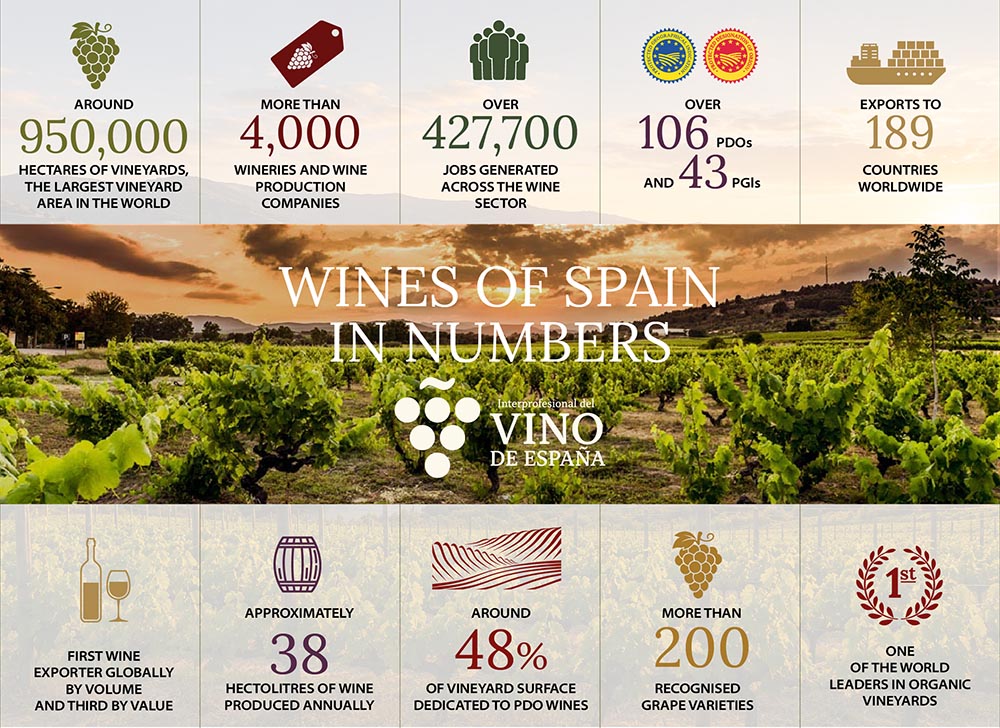
Wine production is deeply connected to Spain’s culture, gastronomy, landscapes and economy. With almost one million hectares of vineyards, the largest vineyard surface area in the world, Spain combines centuries of heritage with innovation, sustainability and a strong commitment to quality. Spanish wines are internationally recognised for their authenticity, diversity and exceptional value, ranging from elegant sparkling wines and fresh Atlantic whites to powerful reds and world-famous fortified wines.
What makes spanish wines unique?
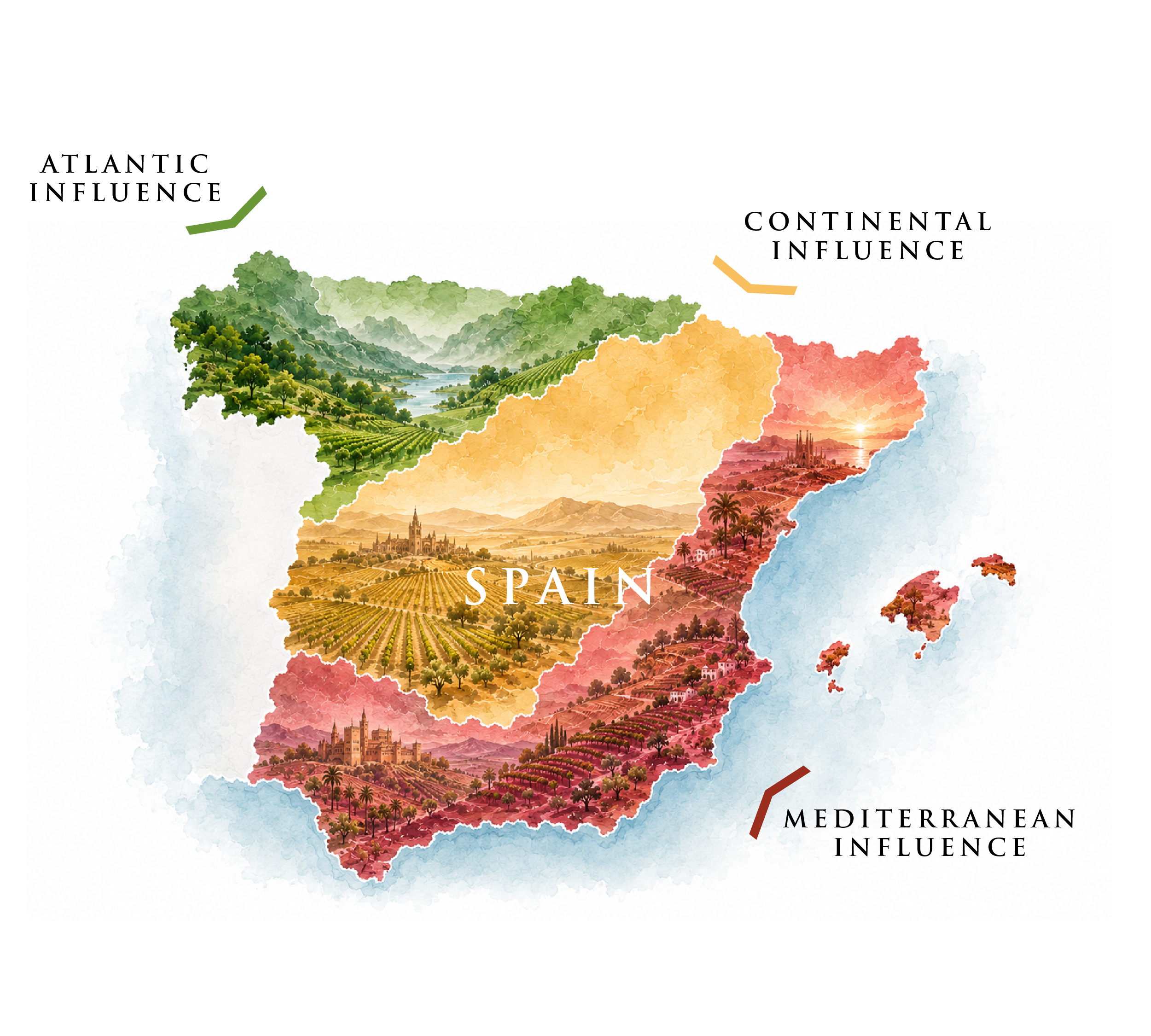
Spain’s diversity is its greatest strength. The country combines Atlantic, Mediterranean and Continental climates, together with dramatic geographical contrasts ranging from coastal vineyards and mountain ranges to volcanic soils and high-altitude plateaus.
Spanish vineyards grow across a remarkable variety of terroirs and soils, producing wines with highly distinctive personalities and styles. The country is also home to more than 200 grape varieties, including internationally recognised native varieties such as Tempranillo, Garnacha, Albariño, Verdejo, Monastrell and Godello.
Tradition and innovation coexist across Spanish wine regions. Historic vineyards, many over 30 years old, coexist with modern sustainable viticulture and organic production practices, positioning Spain as one of the global leaders in sustainable wine production.
Sustainability
Sustainability is increasingly shaping the future of Spanish wine production. Spain is one of the world’s leading countries in organic vineyard cultivation, with more than 120,000 hectares dedicated to certified organic vineyards.
Wine producers across the country are investing in sustainable vineyard management, biodiversity preservation, water efficiency and innovation while protecting local traditions and native grape varieties. This commitment reflects the sector’s dedication to balancing environmental responsibility, economic development and cultural heritage.
Wine tourism
Spain has become one of Europe’s leading wine tourism destinations, offering immersive experiences that combine wine, gastronomy, culture, landscapes and hospitality.
From the vineyards of Rioja and Ribera del Duero to the Atlantic landscapes of Galicia, the Mediterranean coast, Andalusia or the Canary Islands, Spanish wine regions offer exceptional diversity and authenticity. Wineries, wine hotels, gastronomic experiences and cultural routes continue to strengthen Spain’s position as a benchmark destination for wine lovers from around the world.
Spanish wine regions
Indice
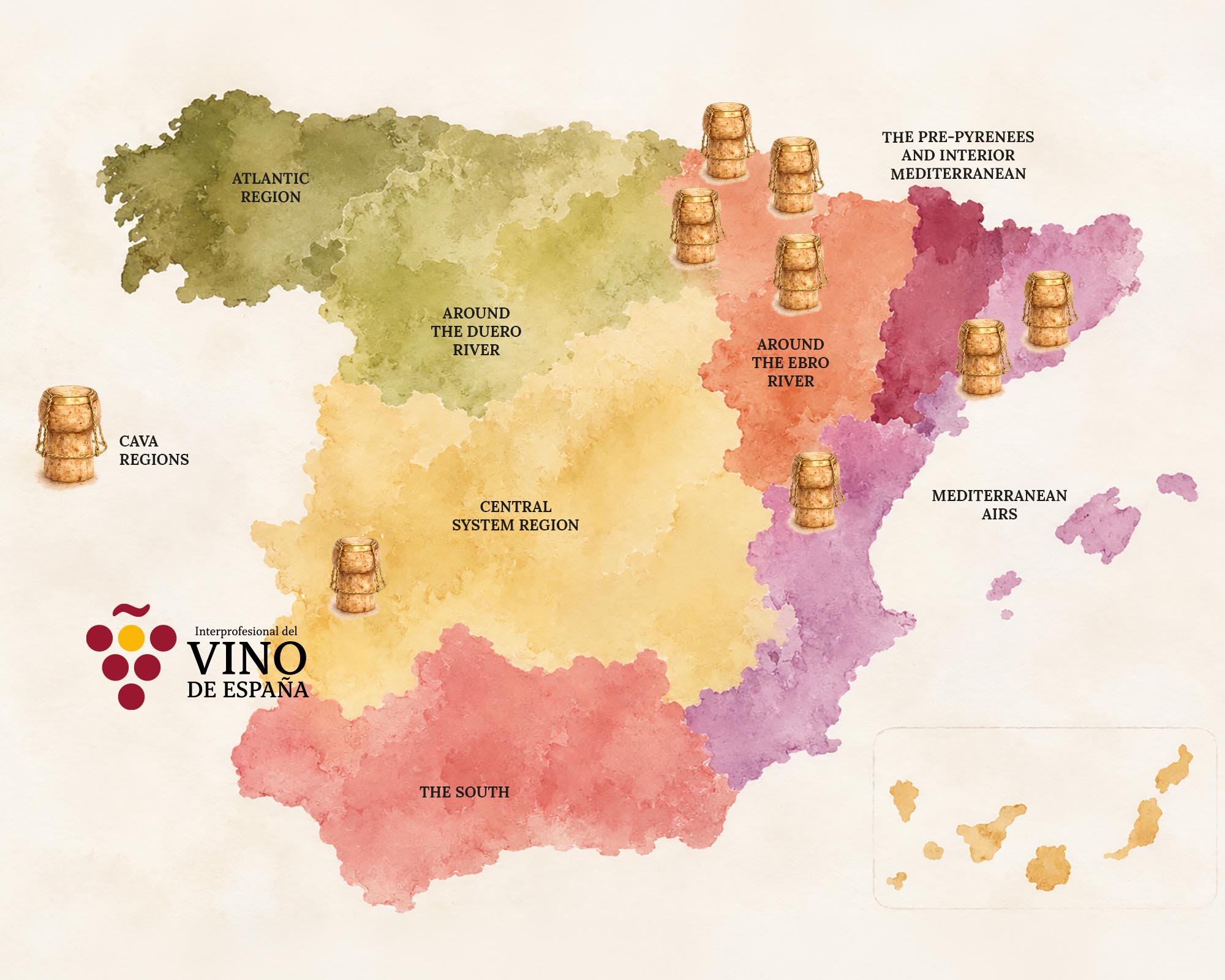
1. ATLANTIC REGION
Stretching across Galicia, the Basque Country and Bierzo, the Atlantic Region is defined by its proximity to the ocean, green landscapes and small vineyard plots. The Atlantic climate brings freshness, vibrant acidity and elegance to the wines, especially the whites, which are internationally recognised for their aromatic intensity and mineral character.
- DO Rías Baixas
- DO Ribeiro
- DO Ribeira Sacra
- DO Valdeorras
- DO Monterrei
- DO Bierzo
- DO Arabako Txakolina
- DO Bizkaiko Txakolina
- DO Getariako Txakolina
- DO Cangas
- Costa de Cantabria VT
- Liébana VT
- Barbanza e Iria VT
- Betanzos VT
- Ribeiras do Morrazo VT
- Valle del Miño-Ourense/ Val do MiñoOurense VT
2. AROUND THE DUERO RIVER
The Duero Valley is one of Spain’s most historic and prestigious wine areas. Shaped by the Iberian Peninsula’s longest river, the region combines altitude, continental climate and diverse soils to produce structured, elegant and age-worthy wines. Ribera del Duero, Toro and Rueda stand among the country’s most internationally recognised appellations.
- DO Ribera del Duero
- DO Arlanza
- DO Cigales
- DO Toro
- DO Rueda
- DO Tierra del Vino de Zamora
- DO León
- DO Arribes
- DO Sierra Salamanca
- DO Valles de Benavente
- DO Valtiendas
- DVP Abadia Retuerta
- DVP Dehesa Peñalba
- DVP Urueña
- Castilla y León VT
3. AROUND THE EBRO RIVER
The Ebro Valley is home to some of Spain’s most iconic wine appellations, including DOCa Rioja. Historic winemaking traditions, diverse terroirs and strong regional identities define this region, where wines combine elegance, structure and international prestige.
- DO Navarra
- DO Campo de Borja
- DO Calatayud
- DO Cariñena
- DOCa Rioja
- DVP Arínzano
- DVP Otazu
- DVP Prado Irache
- DVP Bolandín
- DVP Aylés
- Bajo Aragón VT
- Ribera del Gállego-Cinco Villas VT
- Ribera del Jiloca VT
- Valdejalón VT
- Valle del Cinca VT
- 3 Riberas VT
- Valle de Sadacia VT
- DOP Urbezo
4. THE PRE-PYRENEES AND INTERIOR MEDITERRANEAN
This region combines Mediterranean and continental influences, creating wines with balance, freshness and complexity. Mountain landscapes, varied altitudes and contrasting climates shape distinctive wines from regions such as Priorat, Montsant and Somontano.
- DO Pla de Bages
- DO Costers del Segre
- DO Conca de Barberà
- DO Terra Alta
- DO Montsant
- DOQ Priorat
- DO Somontano
5. MEDITERRANEAN AIRS
The Mediterranean coast is one of Spain’s most diverse wine areas, where sunshine, sea influence and varied landscapes create expressive and approachable wines. The region includes both historic appellations and innovative wine projects, producing everything from fresh whites to powerful reds and sparkling wines.
- DO Tarragona
- DO Alella
- DO Penedés
- DO Empordà
- DO Binissalem
- DO Pla i Llevant
- DO Valencia
- DO Utiel-Requena
- DO Alicante
- DO Jumilla
- DO Yecla
- DO Bullas
- DO Catalunya
- DVP Los Balagueses
- DVP El Terrerazo
- DVP Vera de Estenas
- DVP Chozas Carrascal
- DVP Tharsys
6. CENTRAL SYSTEM REGION
The Central System Region includes Castilla-La Mancha, the largest wine-producing area in the world, alongside regions in Madrid, Extremadura and Castilla y León. Characterised by altitude, continental climate and vast vineyard landscapes, the region combines large-scale production with growing quality and innovation.
- DO Mondéjar
- DO Méntrida
- DO La Mancha
- DO Valdepeñas
- DO Ribera del Júcar
- DO Manchuela
- DO Almansa
- DO Uclés
- DO Vinos de Madrid
- DO Cebreros
- DO Ribera del Guadiana
- DVP Casa del Blanco
- DVP Dominio de Valdepusa
- DVP El Vicario
- DVP Guijoso
- DVP La Jaraba
- DVP Los Cerrillos
- DVP Calzadilla
- DVP Florentino
- DVP Vallegarcía
- DVP Campo de La Guardia
- DVP Dehesa del Carrizal
- DVP Finca Élez
- DO Campo de Calatrava
- DVP Río Negro
- DP Rosalejo
7. THE SOUTH
Southern Spain has a winemaking history spanning nearly 3,000 years. Warm climates, strong sunshine and unique production traditions define the region, internationally famous for fortified wines such as Sherry and the sweet wines of Málaga and Montilla-Moriles.
- Condado de Huelva
- Jerez-Xérès-Sherry
- Manzanilla Sanlúcar de Barrameda
- Montilla-Moriles
- Málaga
- Sierras de Málaga
- Lebrija
- Granada
8. CANARY ISLANDS
The Canary Islands represent one of the world’s most unique wine landscapes. Volcanic soils, Atlantic influence and old indigenous vines create wines with remarkable minerality, freshness and personality. The vineyards, many planted on volcanic terrain around Mount Teide, produce highly distinctive wines unlike anywhere else in Spain.
- Lanzarote
- La Palma
- El Hierro
- Gran Canaria
- Abona
- Tacoronte-Acentejo
- Valle de Güimar
- Valle de la Orotava
- Ycoden-Daute-Isora
- La Gomera
- Islas Canarias
9. CAVA REGIONS
Cava is Spain’s most internationally recognised sparkling wine and the only PDO exclusively dedicated to sparkling wine production. Produced across different regions of Spain using the traditional method, Cava combines freshness, elegance and strong international recognition, with around 65% of production exported worldwide.
- Comtats de Barcelona
• Serra de Mar
• Valls D´Anoia – Foix
• Conca del Gaià
• Serra de Prades
• Pla de Ponent - Valle del Ebro
• Alto Ebro
• Valle del Cierzo - Viñedos de Almendralejo
- Zona de Levante
Main grape varieties
Winemaking registries currently recognize around 280 grape varieties for wine production in Spain. This number is quite high, but it’s just an approximation, as research in recent years has recognised at least 350 varieties. Some of these unknown varieties don’t even have a name and are in the process of being recovered. This is a coordinated effort that includes the participation of researchers, with the help of viticulturists, wineries and different experts in ampelography and edaphology. Wines in Spain can be made using a single grape variety or a blend of different varieties, which is the most traditional way of making wine. Below are some of the most commonly used varieties:
Spanish red wine
grape main varieties
Indice
BOBAL
Native to the region currently known as DO Utiel-Requena in Valencia, it occupies over 70% of vineyards. It is grown over a large part of the Mediterranean coast. Well-suited to aromatic rosés and full-bodied reds.
CARIÑENA
Originally from Aragón, where it gets its name. Although there are some questions about their relationship, it is also known as Mazuelo in Rioja and Samsó in Cataluña. It provides acidity and its high tannin content enables wine to age well.
GARNACHA
This native variety is one of the most widespread in Spanish vineyards and, undoubtedly, the most popular. It is also known as Giró, Lladonera and Garnatxo. It produces wine with a high alcohol content and moderate acidity. It is very popular now thanks to the typicality that if offers from one terroir or region to the next.
MENCÍA
Used mainly in DO Bierzo, although it is also grown in regions of Castilla-León and Galicia. Mencía is one of the five main varieties of native red wine grapes in Spain.
MONASTRELL
This variety is typical of the Levante region, where it is planted in 80% of vineyards in DO Jumilla and in approximately 75% in DO Alicante. It is very drought resistant. It produces expressive wines, with a high alcohol content and medium acidity.
NEGRAMOLL
Especially abundant in the Canary Islands and Palma de Mallorca. This variety is not found in mainland Spain. It produces silky, aromatic wines, with balanced acidity, providing a high degree of freshness.
TEMPRANILLO
A native variety, believed to have originated in La Rioja, this is the most important grape variety in Spain. Tempranillo can be found in approximately 30 DOs and it occupies a quarter of total vineyard area. It has many names depending on the region: Tinta del País, Tinto Fino, Ull de Llebre or Cencibel. Tinta de Toro is a close relative of this variety.
Spanish white wine
grape main varieties
Indice
AIRÉN
Originally from La Mancha, this is the most widely grown white variety in Spain. It is also known as Forcallet, Forcayat, Manchega and Lairén. It is very drought resistant and adapts well to poor soils. Mid to low aromatic intensity, perfect acidity and a good alcohol content.
ALBARIÑO
Grape native to Galicia, very commonly used to make wines in DO Rías Baixas. A very aromatic variety which produces silky, fresh wines with a medium alcohol content. The most relevant characteristic is its distinctive fruity character with a wide variety of aromas.
GODELLO
Native to the northeast, it is mainly used in Galicia and León. It is the most important grape in DO Valdeorras. It can result in varietal wines with a high alcohol content that are balanced, with very characteristic, intense aromas.
HONDARRIBI ZURI
Native to the north and the main variety used to make txakoli in the three DOs in the Basque Country. It produces light, smooth wines with a sharp acidity and citrus aromas. (The red version, Hondarribi Beltza, is less commonly grown)..
MALVASÍA
Very widespread in Spain due to its versatility, it is also known as Subirat. It comes from the Mediterranean basin. It is used for both sweet and dry wines. It is often grown in the Canary Islands. It results in golden, slightly bitter must. It is also suitable for liqueur wines.
MOSCATEL DE GRANO MENUDO
Grown mainly in Málaga and Valencia, it is one of the oldest Mediterranean white varieties. It can also be found in Aragón, Navarra, etc. Its sugar potential is high, with a good balance of acidity and intense flavours. Suitable for natural sweet wines.
PALOMINO
Especially grown to produce fortified wines in Andalucía, mainly in DO Jerez-Xérès-Sherry, to make manzanillas, amontillados, finos and olorosos. It is also known as Listán, Chipiona and Pinchito. It produces wines with a medium alcohol content, and its best expression is when used to make fortified wines, although it is also being used in modern winemaking in other regions.
PARELLADA
Widely used in Cataluña, especially to make cavas, it is the finest of the traditional varieties from Penedès. It produces fresh white wines, with fresh aromas and a delicate acidity. It is also known as Montonec, Verda Grossa, Martorella and Montonega.
PEDRO XIMÉNEZ
This is the reigning variety to make sweet fortified wines. It makes up 90% of grape production in DO Montilla-Moriles. Sun-dried grapes are used for the famous sweet PX. It is a very productive variety that is resistant to high temperatures and drought.
VERDEJO
This is the most important variety used to make wines in DO Rueda. This aromatic, fruity variety produces wines with a fairly high alcohol content, with medium/high acidity, which feature intense aromas that are highly typical of the terroir.
VIURA
The white grape variety most widely used in La Rioja. Also known as Macabeo, in Cataluña it is one of the three main grapes in DO Cava.
XAREL-LO
A grape native to Cataluña and used widely to make cava, along with Parellada and Macabeo. It is a very versatile variety, in which floral aromas predominate. It is one of the three typical varieties for producing cava in Cataluña.
There are many other varieties grown on Spanish vineyards. Although less common, some include: Graciano (red) in Rioja, Navarra and less commonly in Andalucía where it is known as Tintilla de Rota; Garnacha Tintorera, the only variety with violet flesh, also known as Alicante Bouschet; Maturana (white and red); Prieto Picudo (red), very typical of León; Rufete, widespread in Castilla y León, especially in DO Sierra de Salamanca; Trepat (red), very common in DO Conca de Barberà; and white variety Garnacha Blanca, which is mostly grown in Terra Alta.
International grape varieties commonly grown in Spain include reds Cabernet Sauvignon, Syrah, Pinot Noir and Merlot, and whites Chardonnay, Riesling, Gewürztraminer and Sauvignon Blanc.